01 / SHORT ANSWER
Short Answer
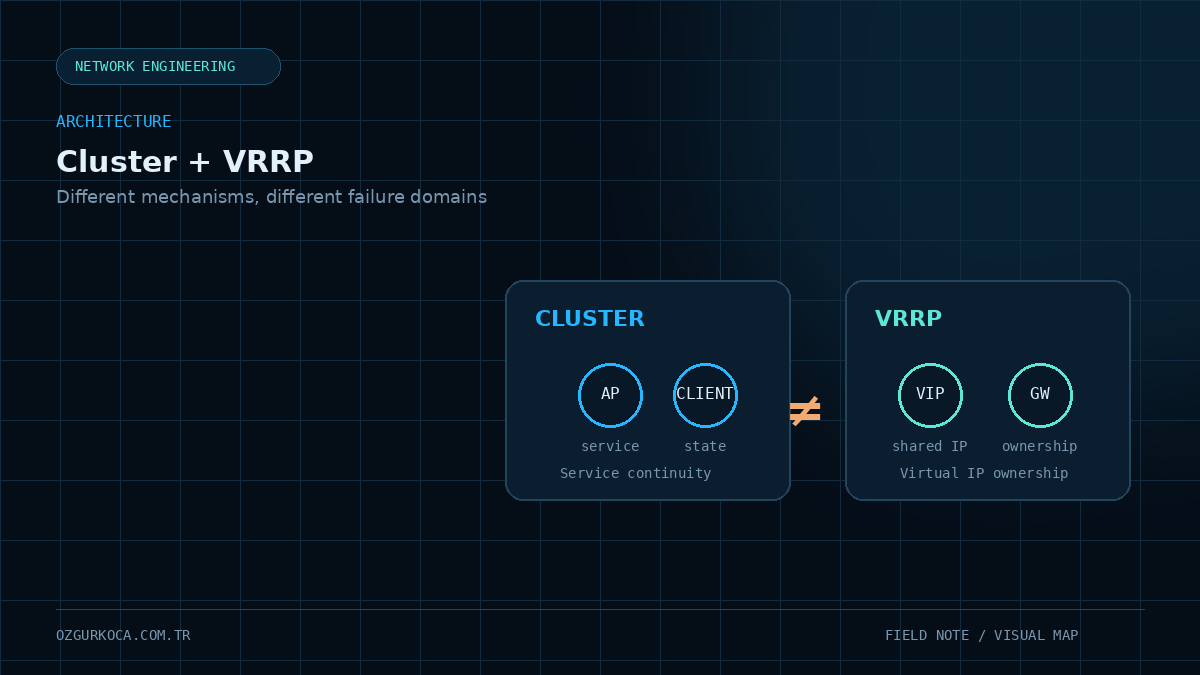
Cluster and VRRP do not solve the same problem. So it is equally wrong to say “VRRP is unnecessary if you already have a cluster” or “every clustered deployment must use VRRP.”
At a high level:
Cluster
  -> AP / client service continuity
  -> load distribution
  -> resilience against controller-node failure

VRRP
  -> a shared Virtual IP (VIP)
  -> active/standby ownership at the IP layer
  -> continuity for a specific service or gateway address
The real question is:
Which IP address are we trying to make highly available with VRRP in this design?
If there is no clear answer, adding VRRP simply because “we need HA” can make the architecture unnecessarily complex.
02 / WHAT DOES THE CLUSTER SOLVE?
What Does the Cluster Solve?
The primary purpose of an ArubaOS 8 controller cluster is to provide service continuity and workload sharing across Managed Devices.
Simplified view:
                 Aruba Cluster

          +-------------------------+
          |                         |
          v                         v
   Controller-A               Controller-B
      AP / Client                AP / Client
          |                         |
          +-----------+-------------+
                      |
                  Wireless
AP and client load can be distributed across multiple controllers. If one node fails, healthy cluster members can take over the service load.
Typical questions answered by the cluster design are:
- What happens to APs if a controller fails?
- How is client service continuity maintained?
- Is load concentrated on one controller or shared?
- How are state and service information maintained across cluster members?
The cluster focuses on the controller service layer.
03 / WHAT DOES VRRP SOLVE?
What Does VRRP Solve?
VRRP takes a different approach.
Two devices share one virtual IP address and the active device owns that address.
             Virtual IP
          <VRRP_VIRTUAL_IP>
                 |
        +--------+--------+
        |                 |
        v                 v
 Controller-A        Controller-B
    MASTER              BACKUP
If the active device becomes unavailable, the VIP can move to the other device.
The basic VRRP question is therefore:
Should access to a specific IP address continue if one device disappears?
VRRP by itself is not an AP/client load-balancing mechanism. It also does not replace the stateful service continuity provided by a controller cluster.
04 / WHY CLUSTER AND VRRP ARE NOT ALTERNATIVES
Why Cluster and VRRP Are Not Alternatives
Separating the roles of the two technologies makes the distinction clearer.
| Capability | Controller Cluster | VRRP |
|---|---|---|
| AP/client service continuity | One of the primary use cases | Does not solve this by itself |
| Controller load distribution | Can provide it | Does not provide it |
| Service continuity after node failure | Through cluster mechanisms | Moves VIP ownership |
| Shared Virtual IP | Not required in every design | Core operating principle |
| Default-gateway redundancy | Not an automatic result of clustering | Can be used on gateway devices |
| Initial AP cluster discovery point | Design-dependent | VIP can be used in an L2 cluster |
That is why both statements below are incomplete:
"We have a cluster, so VRRP is never needed."and:
"We have two controllers, so we must use VRRP."The correct answer depends on the topology and the purpose of the VIP.
05 / VRRP IN A LAYER-2 CLUSTER
VRRP in a Layer-2 Cluster
If controller IPs are in the same Layer-2 broadcast domain, VRRP can have a meaningful role.
In ArubaOS 8 clustering designs where members share the same Layer-2 network, one common design is to create a VRRP instance between cluster members and use the VIP as the AP Master / initial discovery address.
Example:
                  AP
                  |
                  | Discovery
                  v
        <CLUSTER_DISCOVERY_VIP>
                  |
             VRRP VIP
          +-------+-------+
          |               |
          v               v
   Controller-A      Controller-B
          \               /
           \             /
              Cluster
Instead of depending on the physical IP of a single controller during initial discovery, the AP can use the shared VIP.
The important distinction is:
VRRP helps keep the initial cluster discovery address available; it does not independently manage the AP's final placement or load distribution inside the cluster.
After the AP joins the cluster, cluster-member information becomes more important to its subsequent controller behavior.
06 / THE SITUATION CHANGES IN A LAYER-3 CLUSTER
The Situation Changes in a Layer-3 Cluster
If cluster members are located in different Layer-3 networks, they do not share the same broadcast domain.
In that case, a traditional shared VRRP VIP between the cluster members is not possible.
Example:
Controller-A
10.x.x.x
    |
   L3 Network
    |
Controller-B
20.x.x.x
AP discovery therefore needs a different approach.
One common option is DNS-based discovery that exposes multiple controller addresses to the APs.
                AP
                |
                v
        DNS: aruba-master
          /             \
         v               v
 Controller-A        Controller-B
        \               /
             Cluster
So:
In a Layer-3 cluster, asking “where is VRRP?” may be the wrong question; the topology itself may not support that use of VRRP.
07 / GATEWAY REDUNDANCY IS A SEPARATE DESIGN QUESTION
Gateway Redundancy Is a Separate Design Question
This is one of the most common sources of confusion.
Deploying a controller cluster does not automatically make the default gateway for user VLANs redundant.
First determine where the gateway actually lives.
Scenario 1 — Gateway on Core / Distribution Switches
In many campus networks, client VLAN gateways are located on the core or distribution layer.
Wireless Client
      |
      v
 Aruba Controllers
      |
      v
 Core / Distribution
      |
      +-- Client VLAN Gateway
In this design, default-gateway redundancy is not the responsibility of the controller cluster.
If gateway redundancy is required, it should be provided by the HA/FHRP design on the core/distribution layer.
Adding VRRP to the controller layer does not automatically improve user gateway redundancy.
Scenario 2 — Controller Acts as the Layer-3 Gateway
If the Layer-3 gateway for the VLAN is hosted directly on the controller, the situation is different.
Client VLAN
     |
     v
 <VIRTUAL_GATEWAY_IP>
     |
    VRRP
   /    \
  v      v
Ctrl-A  Ctrl-B
If the gateway IP must remain available after a controller failure, a first-hop redundancy mechanism such as VRRP can become relevant.
The decision therefore starts with this question:
Is the client's default gateway actually hosted on the controller?
If the answer is no, VRRP is not required for gateway redundancy merely because the controllers are clustered.
08 / THE COMMON CAMPUS DESIGN SPLIT
The Common Campus Design Split
In a typical campus architecture, it helps to keep responsibilities clear:
                   Campus Network

        Wireless Service / AP Termination
                   |
                   v
         Aruba Controller Cluster

                   |
                   v

          Routing / Default Gateway
                   |
                   v
          Core / Distribution
In this model:
- Controller cluster → provides wireless service continuity.
- Core/distribution HA → provides routing and client gateway continuity.
- VRRP → is used only where a real shared-VIP requirement exists.
This separation keeps the architecture easier to understand and operate.
09 / WHAT ABOUT EDGE OR SPECIAL DESIGNS?
What About Edge or Special Designs?
Not every environment follows a classic campus pattern.
Before deciding on VRRP, ask:
How do APs discover the controller cluster?
             |
             v
Are cluster members in the same L2 network?
             |
             v
Is a shared VIP required?
             |
             v
Is the client gateway hosted on the controller?
             |
             v
Do CoA or other services point to a specific VIP?
If none of these requirements calls for VRRP, creating an extra VRRP instance just because there are two controllers may only add complexity.
10 / SIMPLE DECISION TABLE FOR CLUSTER + VRRP
Simple Decision Table for Cluster + VRRP
| Scenario | VRRP Evaluation |
|---|---|
| L2-connected cluster and a single AP discovery VIP is desired | Yes, meaningful / common use |
| L3-connected cluster members | No; VRRP is not applicable, consider DNS-based discovery |
| Client gateway is on core/distribution | Not required on controllers for gateway redundancy |
| Client gateway is on the controller and gateway VIP redundancy is required | Yes, evaluate VRRP |
| Goal is AP/client load balancing | No; that is solved by the cluster, not VRRP |
| Goal is simply “add HA” but no VIP purpose is defined | Clarify the requirement first |
11 / A COMMON DESIGN MISTAKE: “LET'S ADD VRRP JUST IN CASE”
A Common Design Mistake: “Let's Add VRRP Just in Case”
More HA mechanisms do not automatically create a more resilient design.
Unnecessary VRRP instances can:
- Make troubleshooting harder.
- Obscure which service a VIP is actually protecting.
- Mix together AP discovery, gateway, and cluster roles.
- Make failover behavior harder for operations teams to understand.
A healthier decision process is:
Define the requirement first
        |
        v
Which service needs redundancy?
        |
        v
Does the cluster already solve it?
        |
        v
Is a shared IP address required?
        |
      +---+---+
      |       |
     YES      NO
      |       |
      v       v
Evaluate    Do not add
VRRP/FHRP   extra VRRP
12 / ARCHITECTURE EXAMPLE 1 — LAYER-2 CAMPUS CLUSTER
Architecture Example 1 — Layer-2 Campus Cluster
                         APs
                          |
                          v
                <AP_DISCOVERY_VIP>
                          |
                         VRRP
                    /             \
                   v               v
           Controller-A       Controller-B
                   \             /
                      Cluster
                         |
                         v
                Core / Distribution
                         |
                         v
                 Client Gateways
Here, VRRP provides a shared VIP for AP discovery.
Client VLAN gateway redundancy is handled on the core/distribution layer.
13 / ARCHITECTURE EXAMPLE 2 — LAYER-3 CONNECTED CLUSTER
Architecture Example 2 — Layer-3 Connected Cluster
                         APs
                          |
                          v
                    DNS Discovery
                     /           \
                    v             v
            Controller-A     Controller-B
              Network-A       Network-B
                    \           /
                      L3 Cluster
Because the controllers are not in the same Layer-2 domain, a VRRP discovery VIP is not appropriate.
Discovery should be designed with a topology-appropriate mechanism such as DNS.
14 / THE MOST IMPORTANT TAKEAWAY
The Most Important Takeaway
If this topic is reduced to one sentence:
The cluster provides controller service continuity and load sharing; VRRP provides continuity for a specific IP address. A design may need both, only the cluster, or no VRRP at all.
So instead of asking:
"Do we have a cluster?"ask:
"Which Virtual IP do I need to protect, for which service, and against which failure scenario?"15 / CONCLUSION
Conclusion
Aruba controller clusters and VRRP are not mutually exclusive, but they do not do the same job.
In a healthy campus design, responsibilities should be explicit:
- Cluster → AP/client service continuity and controller load sharing
- VRRP → continuity for a shared Virtual IP where one is genuinely required
- Core/Distribution HA → routing and default-gateway continuity when gateways live at that layer
For ArubaOS 8 designs, a VRRP VIP can be useful for AP discovery when cluster members share the same Layer-2 network. If members are separated at Layer 3, use a discovery mechanism appropriate to that topology instead.
The best way to think about VRRP is not as “the second HA feature that should always accompany a cluster,” but as an independent architecture tool that solves a specific VIP requirement.
Was this article useful?
Leave a quick signal. Feedback is used to improve existing guides and decide what deserves deeper coverage.